

| Author | Jean de La Fontaine |
|---|---|
| Title | Le corbeau et le renard |
| Year | 1668 |

Jean de La Fontaine – Le corbeau et le renard, illustration by J.-J. Grandville
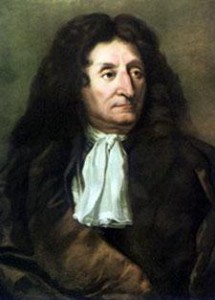
Jean de La Fontaine (1621-1695)
Jean de La Fontaine (1621-1695) was the most important French poet of the 17th century. His main work was Fables choisies mises en vers (Selected fables set in verse), which appeared in 1668.
Never trust a flatterer
Le corbeau et le renard (The fox and the raven) is the second fable of the Fables choisies. It is based on an older fable by Aesop, The fox and the crow: A crow sits in a tree, holding a piece of cheese in his beak. A fox flatters the crow, telling him he is a beautiful bird, and a wonderful singer. He convinces the crow to sing, the crow drops the cheese as he tries to do so, and the fox goes off with the cheese.
In La Fontaine’s version, the crow is replaced with a raven (corbeau).
Le corbeau et le renard
Maître corbeau, sur un arbre perché,
Tenait en son bec un fromage.
Maître renard, par l'odeur alléché,
Lui tint à peu près ce langage:
"Hé! bonjour, monsieur du corbeau.
Que vous êtes joli! que vous me semblez beau!
Sans mentir, si votre ramage
Se rapporte à votre plumage,
Vous êtes le phénix des hôtes de ces bois."
A ces mots le corbeau ne se sent pas de joie,
Et, pour montrer sa belle voix,
Il ouvre un large bec, laisse tomber sa proie.
Le renard s'en saisit, et dit: "Mon bon monsieur,
Apprenez que tout flatteur
Vit aux dépens de celui qui l'écoute.
Cette leçon vaut bien un fromage, sans doute."
Le corbeau, honteux et confus,
Jura, mais un peu tard, qu'on ne l'y prendrait plus.
The Raven and the Fox
The fable was translated into English by Elizur Wright (1804-1885):
Perch'd on a lofty oak,
Sir Raven held a lunch of cheese;
Sir Fox, who smelt it in the breeze,
Thus to the holder spoke:─
"Ha! how do you do, Sir Raven?
Well, your coat, sir, is a brave one!
So black and glossy, on my word, sir,
With voice to match, you were a bird, sir,
Well fit to be the Phoenix of these days."
Sir Raven, overset with praise,
Must show how musical his croak.
Down fell the luncheon from the oak;
Which snatching up, Sir Fox thus spoke:─
"The flatterer, my good sir,
Aye liveth on his listener;
Which lesson, if you please,
Is doubtless worth the cheese."
A bit too late, Sir Raven swore
The rogue should never cheat him more.
Le corbeau et le renard was read as part of the 2007 Once upon a time challenge.
Love the illustration you have pictured. Thanks for translating that, I really appreciate it and enjoyed it.
Just wanted to echo what Carl said – enjoyed this post a great deal.
I remember doing Aesop’s Fables in elementary school. One of these days I might have to revisit them. Or, maybe read new ones not by Aesop. This was an interesting post!
You’ve chosen some very interesting reading for the Once Upon a Time challenge! I enjoyed this post and look forward to your other reviews.
I love this fable. I had to memorize it in High School French class and still remember it. What I found more remarkable was that my grandfather had learned it in French class as well and remembered it some 50 years later. So far neither of my kids is learning French.
La Fontaine’s fables are much liked and admired by me.
The cleverness of French humor is something that tickles my intellectual funny bone. I alos love the illustrations. To me, its incredible how morals and ideas are timeless and can apply long after they were intially written. Its a wonderful thing to invite adults to revist stories that were often part of their childhoods. Funny how these ideas can be reapplied to adulthood!
You can watch(animation), listen, play and read the fable le corbeau et le renard on this beautiful and useful french stories website iletaitunehistoire.com.